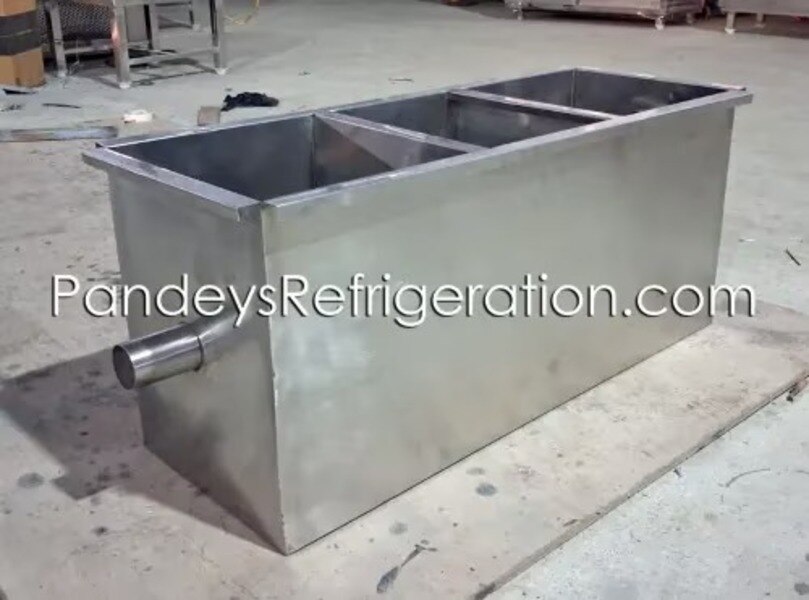
The right supplier depends on more than a stainless-steel box: you need the correct interceptor type, flow rating, capacity, access, and installation arrangement for your kitchen. By the end, you will know what to ask local manufacturers, fabricators, and distributors for, how to compare quotations, and where a low stainless steel grease trap price conceals missing components.
Key takeaways
- Match hydromechanical traps, gravity interceptors, recovery devices, and filters to the job.
- Size the unit from peak kitchen flow and grease load, not outlet diameter alone.
- Request a dimensioned installation drawing before approving stainless steel construction.
- Compare stainless steel grease trap price after delivery, installation, testing, and maintenance costs.
Identify the grease-separation device your kitchen actually needs
Choose a hydromechanical grease trap for one sink or fixture, a gravity grease interceptor for a larger drainage branch, a grease recovery device for continuous skimming, or only a grease filter when you need basic screening.
A commercial kitchen grease trap works by gravity and controlled flow: wastewater enters through the inlet, flow slows inside the chamber, grease and other FOG rise, heavier solids settle, and clarified water leaves through the outlet.
- A grease trap captures FOG near one fixture, with limited solids and grease storage.
- A grease interceptor serves several fixtures or a drainage branch and provides greater settled-solids and grease capacity.
- A grease separator is a broad term for equipment that separates FOG from kitchen wastewater; confirm its flow rating and retention capacity.
- A grease recovery device automatically removes floating grease for collection, but it still needs correct sizing and maintenance.
- A grease filter screens large particles before discharge. It does not provide settled-solids storage or reliable FOG separation.
An oil grease separator supplier may instead offer a hydrocarbon separator for mineral oil, sediment, and fuel contamination. Its sedimentation and coalescing elements do not replace a food-service interceptor designed for fats, oils, and grease.
For a hospital kitchen, size the unit for kitchen wastewater only. Keep clinical, laboratory, chemical, and infectious-waste streams separate; a kitchen grease separator is not general hospital wastewater treatment.
Size the unit from peak kitchen flow, not sink outlet size alone
Size a commercial kitchen grease trap from the whole discharge pattern, not the outlet diameter of one sink. List every connected fixture and calculate simultaneous peak discharge, meals per day, wastewater temperature, detergent use, and grease-storage demand.
Hot dishwasher discharge and emulsifying detergents reduce separation, so ask the supplier of an SS grease separator in Nagpur to assess the full pattern.
Include every fixture that can discharge into the unit:
- Pot-wash sinks
- Dishwashers
- Floor drains
- Vegetable sinks
- Preparation sinks
A 10-litre or 20-litre holding volume does not tell you whether the unit can handle the flow. Request these figures in writing:
| Basis | What to request | Why it matters |
|---|---|---|
| Holding volume | Rated hydraulic flow in litres per minute or gallons per minute, plus grease-retention capacity | A tank volume alone cannot prove separation performance |
| ASME A112.14.3 | Hydraulic flow rate and grease-retention data for the hydromechanical interceptor | These figures allow performance-based comparison |
| PDI G101 | Flow rating and grease-retention performance | A sink outlet rating can hide simultaneous discharge from several fixtures |
| EN 1825 | Nominal size, with the design assumptions for flow, density, temperature, and detergents | An EN 1825 nominal size is not directly interchangeable with a gallons-per-minute rating |
| Discharge pattern | Dishwasher temperature, detergent type, peak timing, and connected drainage branch | Heat keeps fats fluid, while emulsifying detergents carry grease past the separation zone |
Check the installation drawing before choosing stainless steel construction
A dimensioned drawing decides whether an SS grease separator in Nagpur will fit, drain correctly, and remain serviceable. Check overall length, width, height, inlet and outlet elevations, pipe diameter, flow direction, floor loading, ventilation, and clearance above the cover. A narrow access route can make a correctly sized unit impossible to clean.
| Option | Access and maintenance | Civil work and odour control |
|---|---|---|
| Under-sink unit | Easy daily access; limited grease and solids capacity | Minimal work; seal the cover and provide ventilation |
| External above-ground unit | Good inspection, scraping, and pumping access | Requires supports and drainage; venting controls odour |
| Underground interceptor | Large capacity; highest maintenance effort | Requires excavation, structural cover, venting, and safe pump access |
- A removable cover large enough for scraping and inspection, internal baffles or flow-control features, and a cleanout
- Inlet and outlet fittings with matching pipe diameter, durable gaskets, and a route for removing grease without dismantling kitchen equipment
- A dimensioned drawing showing service clearance, lifting access, ventilation, and the load rating of any floor or cover
For the stainless steel grease trap price, ask for SS 304 or SS 316 by component: shell, baffles, fittings, and fasteners. Also request sheet thickness, continuous dressed internal welds, pickling or passivation, and corrosion-resistant fasteners. Choose 316 when chloride exposure, aggressive cleaning chemicals, or saline waste makes pitting likely; SS 304 suits ordinary food-service wastewater.
Find and vet an SS grease trap manufacturer in Nagpur
An SS grease trap manufacturer in Nagpur should give you a performance specification, not only a polished tank. Compare a local manufacturer, sanitary-equipment fabricator, and distributor by sending each the same written brief.
| Supplier type | What to verify | Warning sign |
|---|---|---|
| Local manufacturer | Drawing, hydraulic rating, material traceability, installation scope | Cannot identify who made the internals |
| Sanitary-equipment fabricator | Weld, baffle, passivation, and pressure or leak-check details | Quotes shell dimensions without flow performance |
| Distributor | Original manufacturer, warranty, spares, and local service responsibility | Resells an unnamed unit |
Ask every SS grease separator in Nagpur supplier to state the product category, rated flow, grease-storage capacity, overall dimensions, shell, baffle, fitting and fastener grades, sheet thickness, connection size, fabrication drawing, warranty, delivery time, installation scope, and cleaning access. A quote saying only “10 L” or “20 L” cannot establish commercial performance.
Before choosing an oil grease separator supplier, request these documents:
- Material certificate or grade declaration for each stainless-steel component
- Weld-finish and pickling or passivation details
- Dimensioned general-arrangement drawing with inlet and outlet elevations
- Spare-gasket availability and replacement specification
- References for comparable hotel, restaurant, hospital, or institutional kitchens
- Responsibility matrix covering civil work, drainage connections, venting, lifting, commissioning, and final connection
Pandey's Refrigeration is one Nagpur manufacturer you can ask for a project-specific quotation, alongside other suppliers; compare the documented rating and scope, not the company name alone.
Related product
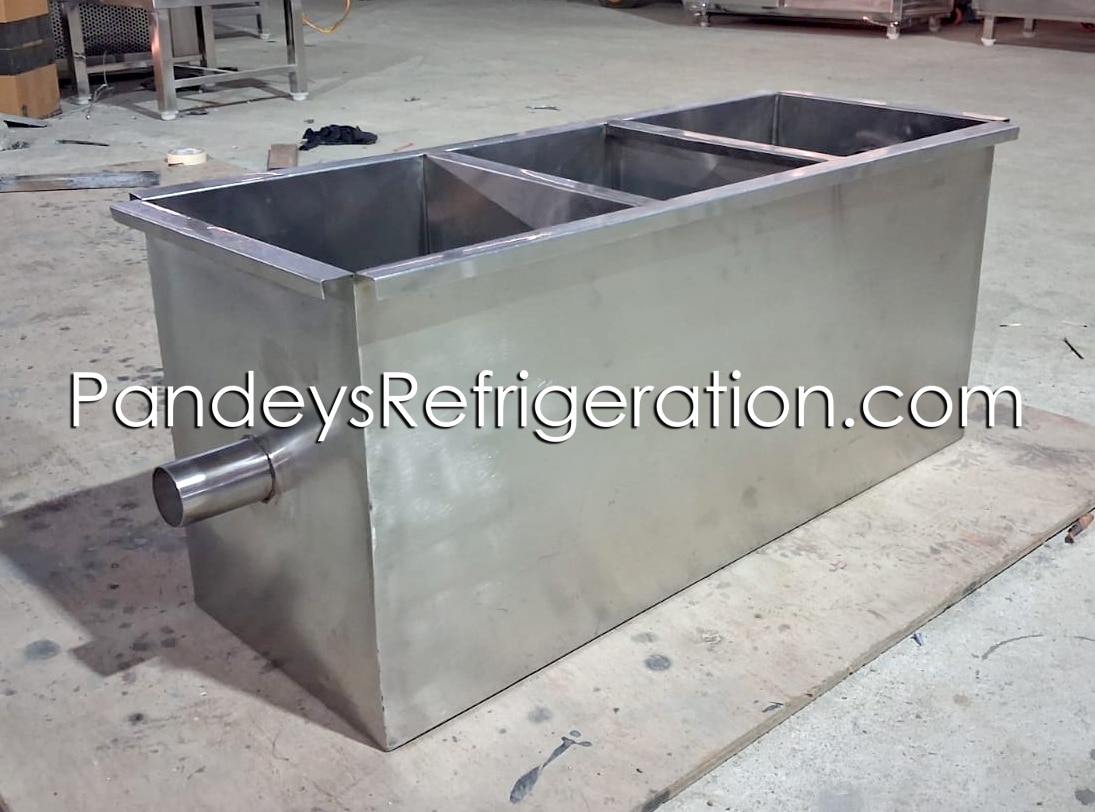 | SS Grease Trap Oil & Grease Separator SS Grease Trap Oil & Grease Separator The PANDEYS SS Grease Trap is a heavy-duty stainless steel oil & grease separator designed for commercial kitchens, hotels, restaurants, and food... View product → |
Compare the stainless steel grease trap price on a complete installed basis
A stainless steel grease trap price is comparable only when both quotations cover the same performance and installation scope. Reject any offer that states only tank dimensions or “20 litres”; volume alone does not show rated flow, grease retention, or solids capacity.
| Offer type | Usually includes | Main risk |
|---|---|---|
| Shell-only fabrication | Stainless body and basic lid | No hydraulic rating, fittings, testing, or installation |
| Equipment supply | Trap, baffles, cover, and connections | Civil work, freight, and commissioning may be excluded |
| Complete installed package | Rated unit, delivery, connections, testing, and handover | Confirm every inclusion in writing |
Use this quotation checklist:
- Confirm steel grade and thickness for the shell, baffles, fittings, fasteners, cover, and gasket; record rated flow, grease capacity, solids capacity, baffle design, inlet and outlet sizes, GST, freight to Nagpur, installation, drainage connections, civil work, venting, testing, commissioning, and warranty.
- Require a responsibility matrix naming who supplies supports, excavation, covers, pipework, traps, lifting equipment, and the final connection.
- Ask for staff inspection access, a written cleaning procedure, weekly inspection guidance, and a maximum grease-layer or storage condition. Set cleaning before grease and solids reach 25% of the working depth unless the supplier specifies a stricter limit.
- Price labour and downtime: an undersized cover can force staff to dismantle kitchen equipment and scrape blindly, while an inaccessible interceptor turns every pump-out into a costly service visit.
Before payment to an ss grease trap manufacturer in nagpur, attach the approved drawing, hydraulic rating, grade declaration, delivery date, warranty, and maintenance instructions to the purchase order.
Frequently asked questions
Which grease-separation device does a commercial kitchen need?
Use a hydromechanical grease trap for one sink or fixture, a gravity grease interceptor for a larger drainage branch, a grease recovery device for continuous skimming, and a grease filter for basic screening.
How do you size a commercial kitchen grease trap?
Calculate capacity from peak kitchen flow and connected fixtures, then check the required retention time and grease-loading conditions rather than sizing from the sink outlet alone.
What should you check in an installation drawing?
Check inlet and outlet positions, pipe diameter, access for cleaning, venting, floor space, maintenance clearance, flow direction, and connection elevations.
How should you compare stainless steel grease trap prices?
Compare the complete installed cost, including fabrication, delivery, civil work, pipe connections, testing, access covers, cleaning requirements, and ongoing maintenance.
Keywords