The phrase “hot case” covers several different machines, from a dry holding cabinet to a wet bain-marie and a heated display unit. By comparing suppliers, heating methods, capacity, installation requirements, and food-safety performance, you can order a cabinet that fits your kitchen instead of paying for unsuitable capacity or heating power.
Key takeaways
- Ask every supplier for cabinet dimensions, electrical load, warranty, and service terms.
- Choose dry heat, humid heat, or bain-marie heating for the food you hold.
- Measure doorways, service clearance, power points, and ventilation before ordering.
- Specify holding temperature, tray sizes, testing method, and acceptance conditions in writing.
Compare Nagpur suppliers by what they can document
A quotation becomes comparable only when it documents the cabinet, its electrical load, and the service plan. Search for an SS hot case supplier in Nagpur and a commercial food warmer in Nagpur, then ask each shortlisted seller for the same evidence.
| Seller type | Strength | Risk to verify |
|---|---|---|
| Local manufacturer | Can alter tray spacing, counter height, door style, insulation, castors, and electrical configuration; may provide site measurements and Nagpur service | Confirm whether the unit is standard or made to order, and whether parts can be reproduced |
| Dealer | Faster delivery and several brands | Identify who installs the cabinet and supplies heaters, thermostats, gaskets, and switches |
| Fabricator | Can build unusual dimensions | Inspect welds, food-contact surfaces, controller quality, and after-sales responsibility |
| Online supplier | Useful for standard models | Check freight damage liability, return cost, spare-part access, and voltage details |
Before comparing prices, request:
- A dimensional drawing, pan standard, usable depth, shelf spacing, included accessories, operating temperature range, total wattage, and electrical nameplate
- Stainless-steel grade for food-contact surfaces, body, shelves, and frame, not merely “SS body”
- Warranty exclusions, lead time, installation requirements, replacement-part availability, and service response time in Nagpur
A fabricator’s attractive price does not compensate for rough welds or an unserviceable controller. A dealer’s stock does not help if nobody accepts installation responsibility. A quotation saying only “commercial SS hot case” or “six trays” is not a basis for a safe buying decision.
Match the heating method to the food you hold
Choose dry heat, a wet bain-marie, a heated display case, or an insulated carrier according to the food, not the label “hot case.”
| Option | What it does | Best fit | Main risk |
|---|---|---|---|
| Dry-heated cabinet | Warms with heated air | Plated meals and covered pans | Extended holding dries rice, gravies, roti, baked goods, and fried snacks |
| Wet bain-marie | Transfers heat through hot water | Dal, sauces, rice, gravies, and curries | Condensation softens roti, papad, and fried snacks |
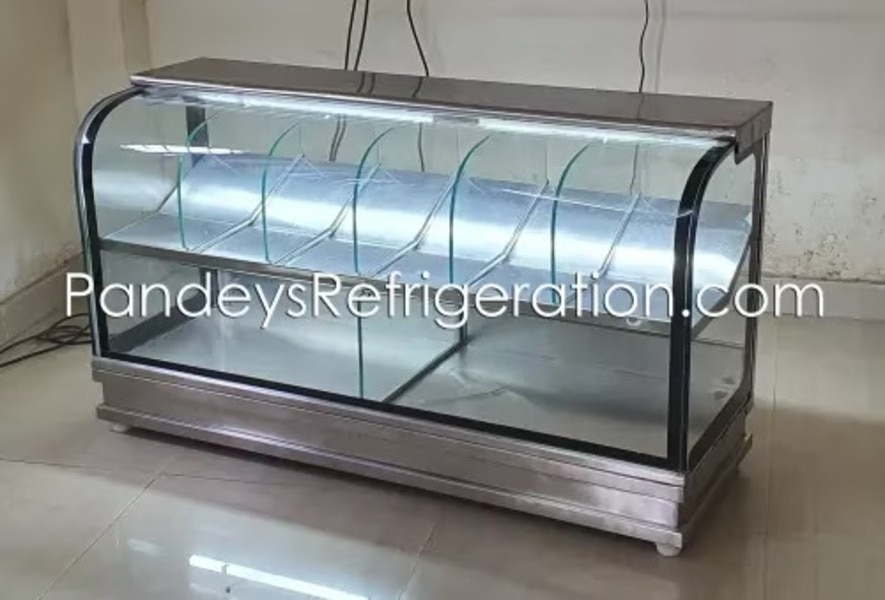
| Heated display case | Holds food visibly for service | Short holding where customers choose products | Poor airflow control can create uneven temperatures |
| Insulated carrier | Retains existing heat without electricity | Transport or sites without safe power | It cannot maintain temperature indefinitely |
Use separate zones or covered pans when one menu includes moist curries and crisp snacks. A dry-heated stainless steel food hot case protects crispness better, but prolonged exposure still degrades texture.
Treat a holding cabinet as a temperature-maintenance unit, not a reheating oven. Buy it for reheating chilled food only when the manufacturer explicitly rates it for that duty.
For a commercial SS hot case in Nagpur, ask for the thermostat range, water-pan or humidity controls, door-gasket sealing, and temperature recovery after opening. A loaded demonstration with your pans, rice, gravy, and fried items reveals more than heater wattage or a catalogue photograph.
Check top-to-bottom temperature variation, condensation, noise, and electrical current draw before choosing.
Calculate capacity and confirm the cabinet fits your Nagpur site
Size the cabinet from the pans you use, not from a seller’s “six-tray” label. Count pans held during one service period, record each length, width, and depth, then add space for the next menu expansion and enough clearance for loading and air circulation.
1. Confirm the rail standard: GN 1/1, GN 2/1, Indian hotel pans, or custom trays. Record usable pan dimensions, pan depth, lids supplied, shelf spacing, and clearance above each pan. Match this capacity to servings per hour and replenishment frequency.
2. Check the serving-line footprint. Measure counter depth, door or shutter swing, clearance beside dispatch, and room for staff to remove pans without blocking a passage. A cabinet that holds the menu but obstructs service is the wrong commercial SS hot case in Nagpur.
3. Measure the complete delivery route before ordering: kitchen doorway, corridor turns, lift door and cabin, stair width, and final placement area. Leave working access for cleaning, thermostat replacement, heater servicing, and drainage.
4. Give the electrical details to the seller. Confirm voltage, 50 Hz frequency, single- or three-phase supply, earthing, breaker capacity, total wattage, isolator distance, and plug or hard-wiring requirements for a commercial food warmer in Nagpur.
Choose castors only when the floor is level, brakes hold, cables stay protected, and staff can clean beneath the unit. Otherwise specify fixed adjustable feet. A dimensional drawing and electrical nameplate should match your measured site before you pay.
Turn the quotation into a testable equipment specification
Treat the quotation as a pass-or-fail specification, not a description. A stainless steel food hot case is acceptable only when its performance, construction, electrical load, and service support are written down and then demonstrated.
1. Require the operating temperature range, thermostat or digital controller type, sensor position, over-temperature protection, warm-up time, and expected recovery after door opening. Record supply voltage, frequency, phase, total wattage, full-load current, plug or hard-wiring requirement, isolator, and earthing arrangement.
2. Demand separate material grades for food-contact surfaces, body, shelves, and frame: 304, 316, or 430 stainless steel. Specify sheet thickness, folded edges, internal bracing, continuous welds, radiused internal corners, removable shelves, accessible drainage, and a door gasket that can be removed and cleaned.
3. Inspect the delivered cabinet for distorted welds, unsupported shelves, exposed insulation, blind crevices, silicone-filled joints, and poor door alignment. Confirm that heating elements are reachable without dismantling the entire cabinet, and ask whether spare heaters, thermostats, switches, and gaskets are stocked.
4. Ask a restaurant hot case manufacturer such as Pandey's Refrigeration for a loaded demonstration using your pans and representative food. Measure warm-up time, top-to-bottom temperature variation, recovery after opening, door sealing, condensation, noise, and electrical current draw; require the results, custom layout, site-fit check, and Nagpur service arrangement in writing.
Related products
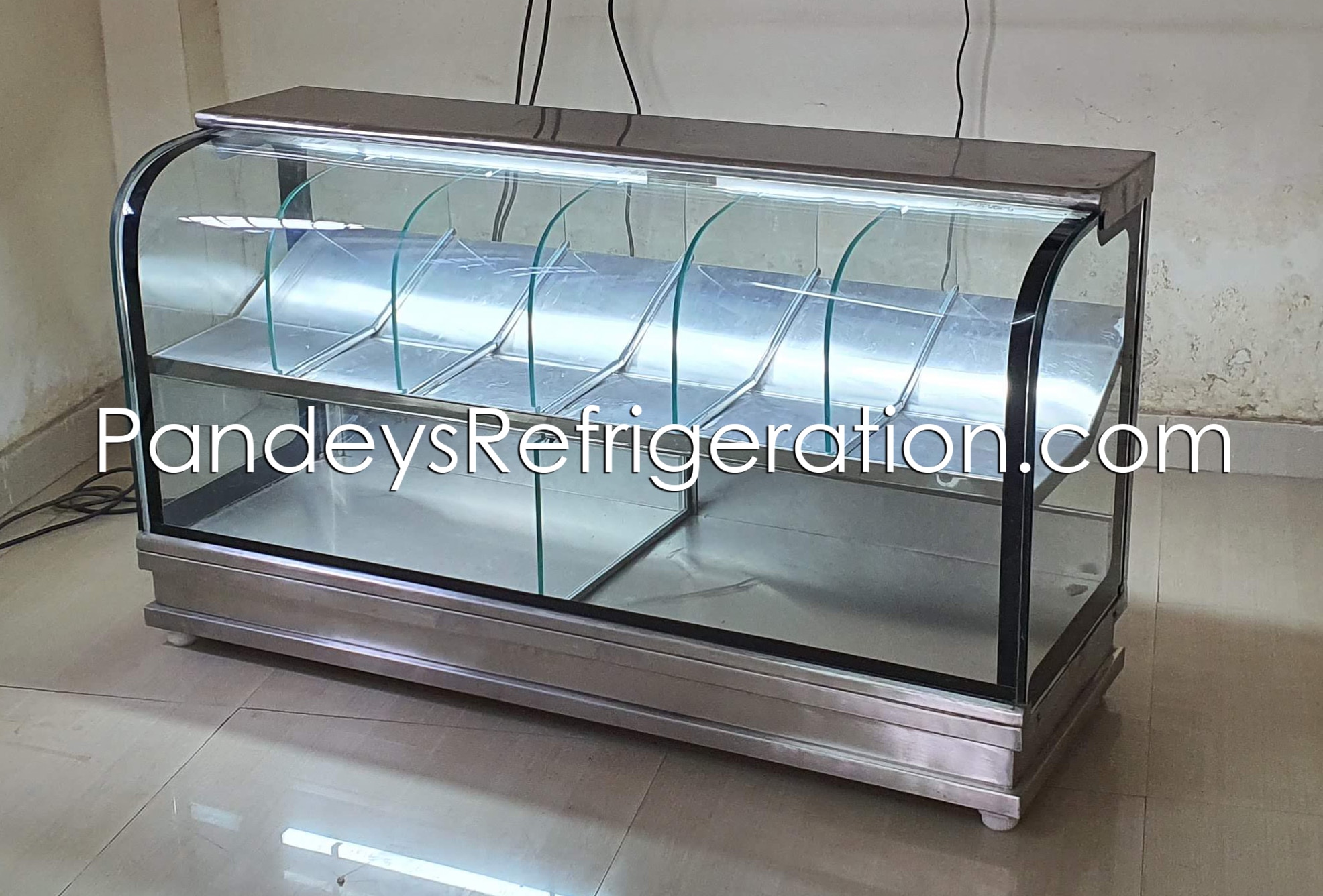 | Hotel Equipments Stainless Steel Hot Case by Pandeys Hotel Kitchen Equipment Product Overview Keep your freshly prepared food hot, hygienic, and ready to serve with... View product → |
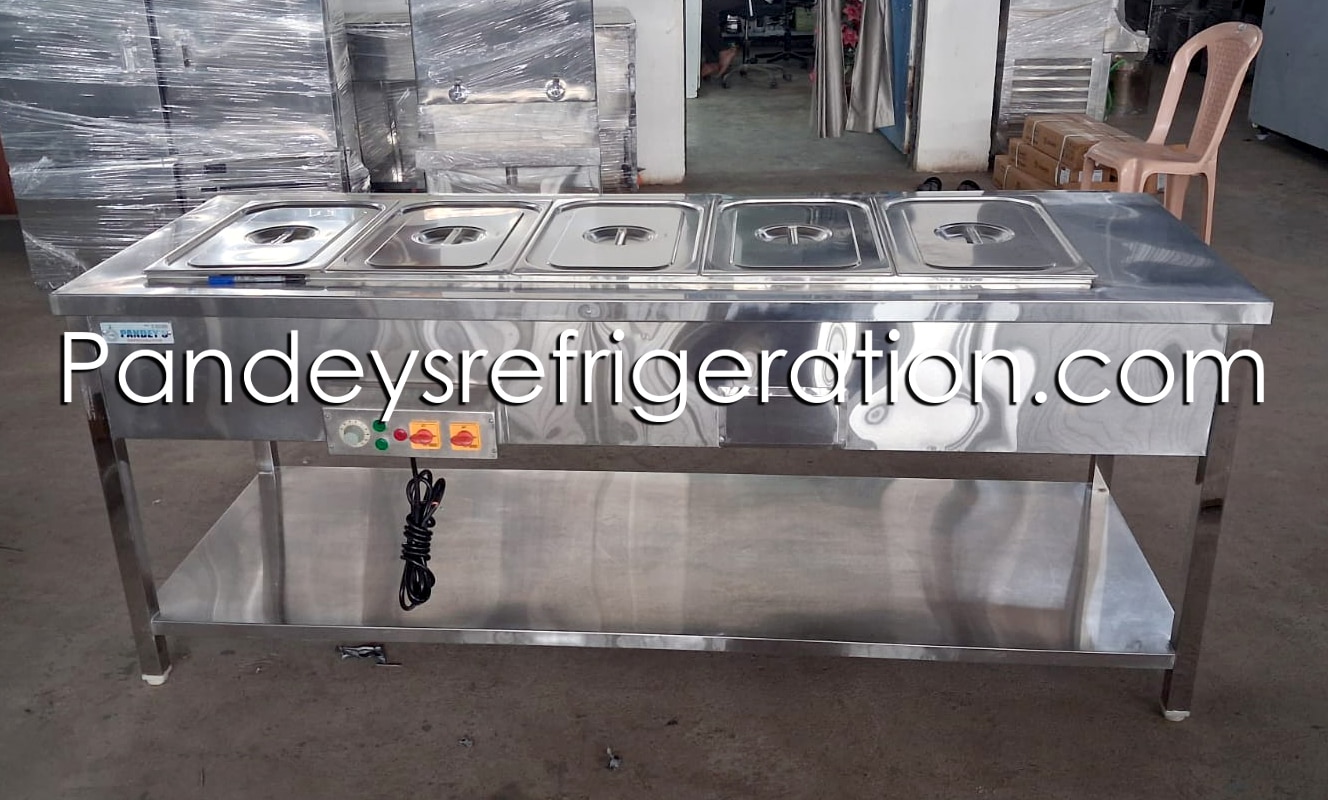 | Hotel Equipments Pandey's Hotel Kitchen Equipment (based out of Nagpur, Maharashtra) manufactures and supplies commercial-grade Stainless Steel (SS) Hot Bain-Marie... View product → |
Commission and operate the hot case as a food-safety control
Set the cabinet to hold food at 60°C or above, then verify the centre of the food with a calibrated probe thermometer. Do not accept the cabinet display as proof: air temperature can differ from food temperature.
During commissioning, preheat the cabinet and test loaded pans at the top, middle, and bottom positions. Repeat the readings after opening the door for a service cycle.
| Test | What to check | Corrective action |
|---|---|---|
| Food centre | Rice, sauce, and gravy reach at least 60°C | Adjust the controller, load, or pan position |
| Door recovery | Temperature returns after service opening | Reduce load or investigate the heater and gasket |
| Air circulation | Pans do not block vents or overfill shallow trays | Re-space pans and reduce fill depth |
Keep lids closed when service allows. Stir thick gravies where the process permits, and separate crisp foods from humid compartments. Limit time between 5°C and 60°C, follow your documented food-safety procedure, and discard food beyond its approved holding limit.
Whether you bought from a commercial food warmer in Nagpur listing or an SS hot case supplier in Nagpur, record the model, serial number, load, measured temperatures, probe calibration check, and corrective action. This record matters more than heater wattage.
After service, clean and dry removable shelves, water pans, drains, gaskets, and food-contact surfaces. Remove standing water and residue from hidden corners; moisture and grease there become contamination points.
Frequently asked questions
How should you compare SS hot case suppliers in Nagpur?
Give each supplier the same request and compare documented cabinet dimensions, stainless-steel grade, electrical load, heating method, warranty, spare parts, and service response.
Which heating method suits different foods in a hot case?
Use dry heat for foods where surface crispness matters, humid heat for foods that lose moisture, and bain-marie heating for covered trays that need gentle, even holding.
How do you calculate hot case capacity and confirm it fits your site?
List the trays or containers you will hold, calculate usable shelf space, then measure the cabinet route, doorway width, counter depth, service clearance, power point, and ventilation space.
What should a hot case quotation specify?
Require the quotation to state external and internal dimensions, tray capacity, material, heating method, voltage, wattage, controls, temperature range, warranty, installation, and acceptance testing.
How do you commission and operate a hot case safely?
Record the warm-up time and temperatures at loaded shelves, verify the thermostat with a calibrated thermometer, keep food covered, and log holding temperatures during service.
Keywords