Choosing a fryer for samosa, kachori, bhajiya, jalebi or sev requires more than comparing litre capacity or stainless-steel panels. By the end, you can calculate peak-hour demand, compare gas and electric specifications, assess oil-management features and question Nagpur suppliers about installation, service and spare parts.
Key takeaways
- Match oil capacity to tested peak-hour batch throughput.
- Compare recovery time, not tank size alone.
- Choose temperature control for each farsan product.
- Demand commissioning, fabrication details and service commitments in writing.
Match Oil Capacity and Recovery Time to Peak-Hour Demand
Choose a fryer by oil volume and tested batch throughput, not tank size alone. An 8–12 litre vat is not automatically an 8–12 kg-per-hour machine: moisture, frozen or fresh loading, basket weight and the set temperature change actual output.
Calculate your busiest-hour requirement in kilograms, then request a tested kg/hour figure for the exact product and oil temperature.
| Shop type | Capacity and performance target | What to verify |
|---|---|---|
| Small farsan shop | A compact vat sized for one manageable batch and your peak-hour kg requirement | Basket load, recovery time after that load, and whether a second vat is needed for different products |
| High-volume outlet | Multiple vats or a larger floor unit with documented continuous throughput | Recovery time between defined batches, simultaneous production and oil-change downtime |
| Bakery | Capacity matched to continuous dough production, not the largest oil tank | Cold zone, removable sediment screen and access for daily flour and crumb removal |
Ask a commercial deep fryer in Nagpur supplier to state the minutes required for oil to return to the operating temperature after a specified load, such as samosa, kachori or bhajiya. Heater wattage alone proves little; poorly immersed or widely spaced elements can recover slowly.
A farsan shop fryer in Nagpur also needs a drain that safely handles the full oil charge and a tank you can clean without reaching around trapped residue. For bakery production, easy crumb removal protects oil quality and prevents burnt particles from carrying into later batches.
Compare Countertop, Floor-Standing, Kadai-Style and Continuous Fryers
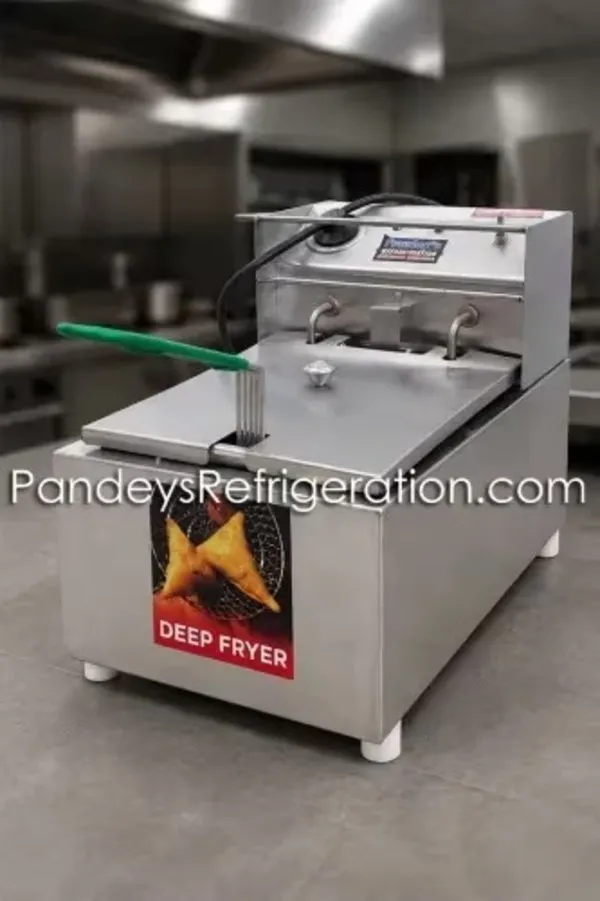
Countertop models suit a small shop with limited floor area and one or two baskets. Floor-standing fryers provide larger working height, multiple vats and easier separation of products, making them better for a busy outlet.
| Option | Best fit | Main limitation |
|---|---|---|
| Countertop | Small batches, restricted space | Limited basket load and recovery |
| Floor-standing | High-volume samosa, kachori or bhajiya production | Needs floor space, canopy clearance and access |
| Kadai-style | Jalebi, sev and traditional manual frying | Less precise temperature control and slower handling |
| Continuous | Bakery dough products and steady production | Higher cost and unnecessary for intermittent demand |
A continuous fryer suits a bakery that feeds dough at a steady rate. Specify a cold zone, removable sediment screens and daily crumb access; flour and fine crumbs otherwise burn and carry dark particles into fresh oil.
A stainless steel deep fryer in Nagpur is the better choice where wet cleaning, salt, chloride-containing chemicals or long service life matter. Ask the supplier to state SS 304 or SS 202 and sheet thickness separately for the tank, body, legs and baskets; “stainless steel” alone proves little.
An iron kadai can suit low-cost, manual batches when staff accept seasoning, drying and rust prevention. Choose stainless steel for easier sanitation and corrosion resistance, but inspect weld finish, usable oil depth, basket dimensions, insulation and leg levelling before paying.
Check Fuel, Heating, Temperature Control and Installation Requirements
Ask for a fuel-specific specification, not “gas compatible.” LPG and PNG need different regulators, jets and combustion settings; using the wrong setup creates poor heating, soot or an unsafe flame. Electric models must match the shop’s sanctioned load.
| Fuel | Specifications to verify | Installation checks |
|---|---|---|
| LPG | Burner rating, inlet pressure, nozzle size, regulator, hose and flame-failure device | LPG cylinder manifold, shut-off valve, ventilation and clearance |
| PNG | Burner rating, operating pressure, jet configuration and gas-train details | Approved gas line, isolation valve, leak test and combustion adjustment |
| Electric | Connected load, phase, current, heating-element rating and plug or isolator | Cable size, MCB, RCCB, earthing and three-phase availability |
A 6 kW fryer draws about 26 A at 230 V before other equipment is counted. A 12 kW model generally needs a properly sized three-phase supply, so obtain the supplier’s electrical drawing before ordering.
Specify a thermostat range covering 170–190°C, control accuracy, an independent high-limit cut-out and a sensor positioned in the oil zone, not beside the element. Request tested kilogram-per-hour output at your product, basket load and target temperature; an 8–12 litre vat does not guarantee 8–12 kg per hour.
For commercial frying equipment in Nagpur, inspect the cleaning design as closely as the finish:
- Choose smooth welded food-contact joints, rounded internal corners, removable baskets or elements and a drainable vat.
- Record commissioning results, including temperature recovery, leak or insulation tests and safety-cut-out operation.
- Include an oil-discard procedure based on total polar compounds; discard oil above 25%, rather than judging by colour alone.
Set Temperatures and Manage Oil for Different Farsan Products
Keep common farsan oil between 170°C and 190°C, then confirm recovery after every loaded batch. A fryer that reads 180°C before loading but needs several minutes to recover will produce greasy samosa, kachori or bhajiya. Ask for tested recovery time at your actual basket load, not only the heater rating.
| Product group | Operating and oil-control practice | Replace or separate when |
|---|---|---|
| Savoury farsan | Hold the recipe temperature within 170–190°C; skim crumbs between batches and filter after service | Besan sediment burns, oil foams, smokes or darkens |
| Sugar-based sweets | Use a separate tank for jalebi and other sugar-shedding products; remove syrup particles quickly | Sweet residue changes flavour or causes persistent foaming |
| Bakery dough products | Use a cold zone, sediment screen and daily crumb removal; avoid flour carryover | Crumbs scorch or the oil develops a stale smell |
Filter oil only through the fryer’s removable screen or a suitable fine filter after it has cooled to the equipment’s safe handling temperature. Never open a drain over a small or unstable container; a farsan shop fryer in Nagpur needs a low-point valve that safely holds the full oil charge.
Replace oil when smoke appears below the normal setting, the oil smells stale, foams repeatedly or leaves excessive dark residue. Do not extend its life by continuously topping up. A bakery deep fryer supplier in Nagpur should specify filter access, cold-zone cleaning and the drain design before you compare quotations.
Compare Nagpur Suppliers on Fabrication, Commissioning and Service
Before accepting a quotation, make every commercial deep fryer in Nagpur supplier specify fabrication, commissioning and service in writing. A polished exterior proves little if the tank welds trap crumbs, the legs cannot be levelled, or the drain valve fails during production.
| Quotation area | Ask for | Reject or clarify |
|---|---|---|
| Fabrication | SS 304 for tank, baskets and food-contact surfaces; separate sheet thicknesses for tank, body, legs and accessories; usable oil depth, basket dimensions, cold-zone depth, insulation, splash guard and factory test at operating temperature | “Stainless steel” with no grade, thickness or weld-finish detail |
| Commissioning | LPG or PNG fuel, burner rating, gas pressure, nozzle and regulator setup; or connected kW, phase, cable size, MCB/RCCB and isolator requirements for electric models | “Gas compatible” or an electrical load that exceeds your supply |
| Service | Warranty exclusions, spare-part stock, service area, installation charge and response time for a failed thermostat, high-limit cut-out, heating element, gas valve or drain valve | Verbal warranty promises or no production-critical response commitment |
Ask whether the supplier will level the unit, test temperature recovery with oil at operating temperature and hand over operating instructions. For a bakery deep fryer supplier in Nagpur, also request a removable sediment screen and accessible cold zone for flour and crumb removal.
Include Pandey's Refrigeration in the same written comparison, using identical questions on tank construction, commissioning and response time. That makes a stainless steel deep fryer in Nagpur easier to compare on serviceability rather than appearance.
Related product
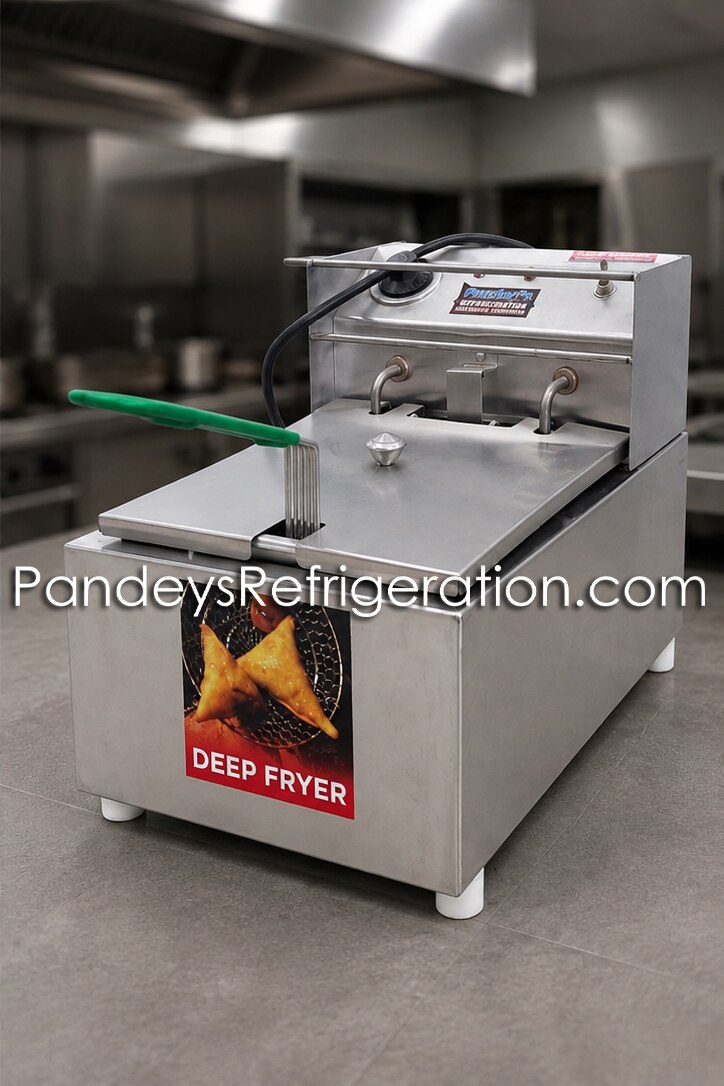 | Hotel Equipments by Pandeys Hotel Kitchen Equipment Product Overview The SS Deep Fryer by Pandeys Hotel Kitchen Equipment is a high-performance commercial frying... View product → |
Frequently asked questions
How do you match fryer capacity to peak-hour demand?
Compare tested kilograms per hour and recovery time at your actual batch size, oil temperature and product moisture. An 8–12 litre vat does not automatically produce 8–12 kilograms per hour.
Which fryer type suits a farsan shop?
Countertop fryers suit limited-volume menus and small kitchens. Floor-standing fryers provide more capacity. Kadai-style fryers suit traditional batch frying, while continuous fryers fit high-volume, consistent products.
What should you check before installing a commercial fryer?
Confirm fuel type, electrical load, ventilation, exhaust clearance, drain access, floor space and temperature-control requirements. Ask the supplier for installation drawings and commissioning details.
How should you manage oil for different farsan products?
Set the temperature for the product and avoid overloading the basket, because wet or crowded loads drop oil temperature. Filter oil, remove crumbs and discard it when darkening, foaming, smoke or off-flavours appear.
How do you compare commercial deep fryer suppliers in Nagpur?
Ask each supplier for material thickness, heating-system details, controls, tested throughput, installation scope, commissioning, warranty terms and response arrangements for service.
Keywords