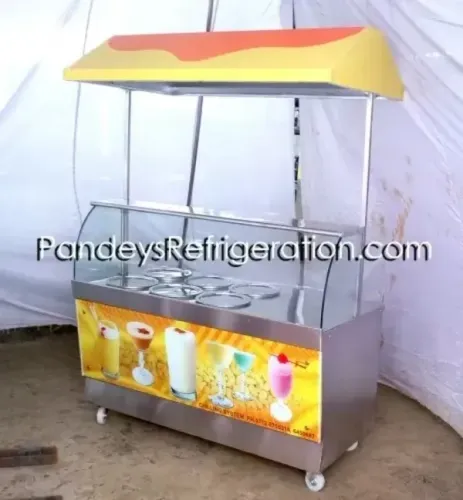
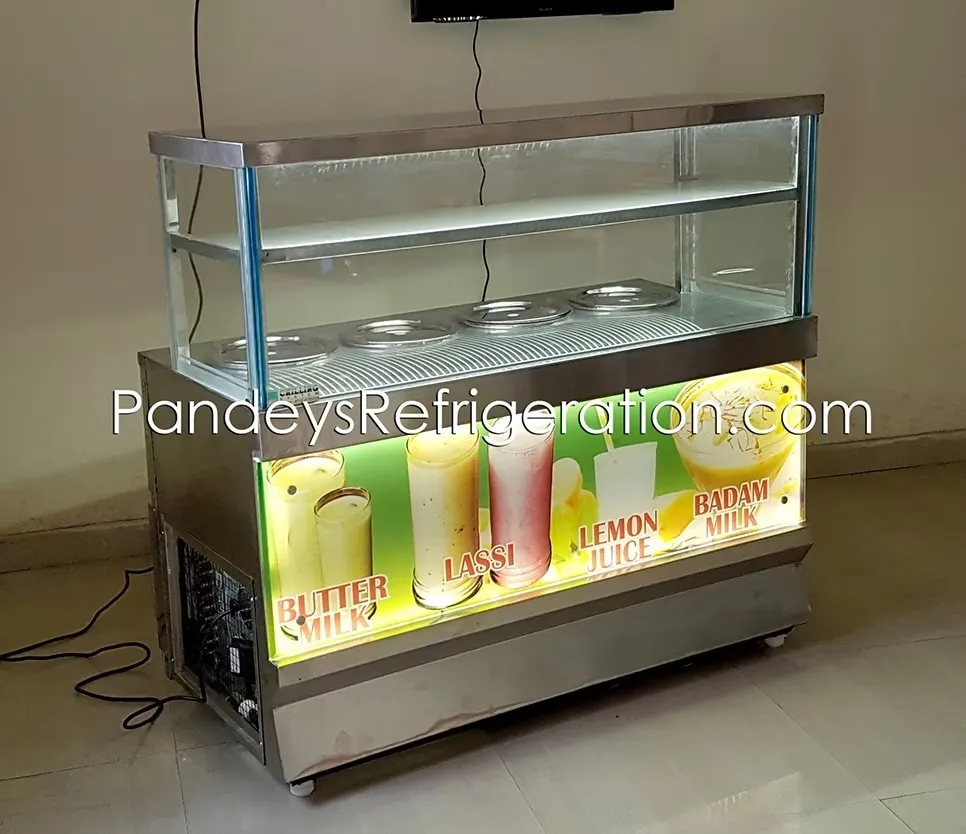
A lassi counter can fit the available wall length and still disrupt service, overheat beside a fryer, or leave dairy above a safe serving temperature. By checking the layout, cooling method, hygiene details, electrical load, and supplier commitments before payment, you can reject a unit that looks suitable only in photographs.
Key takeaways
- Measure staff and customer routes, not just the available wall length.
- Match cooling capacity and storage volume to your busiest service period.
- Inspect every tank, drain, joint and splash area for cleanability.
- Get dimensions, steel grade, warranty, testing and exclusions in writing.
Will the counter fit your shop’s service route?
A counter fits when its dimensions support the service route, not merely when it fits along a wall. A practical checklist for a lassi counter for buying problems in Nagpur starts with the route, not the catalogue.
Measure the blender footprint, cup and topping storage, hand-washing path, customer queue, service-side aisle, door swing, and access needed to remove the compressor. A deep unit can consume the preparation aisle and force dairy containers through a farsan production area.
Match the layout to the operation:
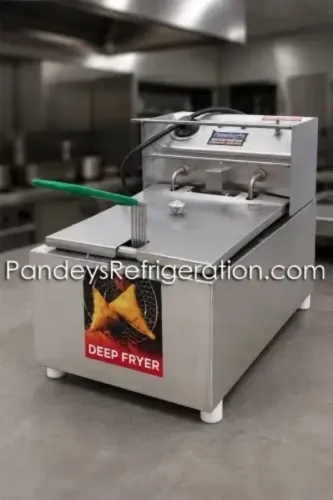
- For a farsan shop lassi counter, keep the dairy route away from frying traffic; allow heat shielding, condenser ventilation, and service clearance beside the fryer.
- For a small stall, prioritise a short, shallow unit with under-counter storage and a queue that does not block the entrance.
- For a restaurant, place the blender, cups, taps, and chilled storage in one operator zone so staff do not cross the dining or kitchen route.
- For a hotel buffet, check customer-side clearance, sneeze-guard reach, refill access, and whether staff can open the storage compartment without entering the queue.
- For takeaway service, provide landing space for filled cups, payment, lids, and pickup orders without blocking the hand-washing route.
Confirm the counter’s length, depth, height, insulated or refrigerated storage, and operating temperature. Ask whether chilling uses a compressor, ice bed, or cold plate; each changes electrical load, refill work, and maintenance.
Are the cooling system and capacity suitable for peak demand?
A cabinet set to 2–4°C can still serve warm lassi. For an SS lassi counter in Nagpur, measure the drink at the tap or serving container after normal loading and repeated service; accept it only when the product remains at or below 5°C.
1. Ask for usable chilled capacity in litres and expected cups per hour, not the cabinet’s outside dimensions. Load the planned number of cans or containers and check that air can circulate around them.
2. Identify the cooling method and its limits:
| Cooling method | What to verify | Main risk |
|---|---|---|
| Compressor | Compressor rating, condenser airflow and recovery time | Poor ventilation reduces cooling |
| Ice bed or cold plate | Ice capacity and hours of cooling | Temperature rises after depletion |
| No active cooling | Ice replacement and holding procedure | Unsuitable for continuous dairy service |
3. Inspect the display protection. Reject an open top with no defined air curtain, lid or sneeze guard for a farsan shop lassi counter exposed to frying vapour, dust and food particles. Put removable glass panels, cleaning access and replacement-glass cost in the quotation.
4. Run the unit on the shop’s actual supply with display lights and blender circuit loaded. Record starting behaviour, running current, plug rating, earthing, overload protection and voltage tolerance; long extension leads and shared circuits can cause trips and weak cooling.
Before paying, repeat the test with frequent service opening and confirm the condenser is ventilated, away from fryer heat, and accessible for cleaning. Photographs cannot prove temperature recovery or usable capacity.
Can every wet and food-contact area be cleaned properly?
Use the commercial lassi counter checklist to inspect surfaces you cannot judge from the front. Specify SS 304 for the tank, worktop, sink and splash zones, and identify any lower-cost grade used for legs, cladding or non-food-contact panels. A magnet test does not prove stainless-steel grade.
Reject a unit with rough welds, sharp internal corners, welded-in dead legs or narrow fixed tubes. Milk film trapped in these areas can sour, support microbial growth and remain invisible after wiping.
- Require removable baffles, agitator parts, tap nozzles and drip trays wherever dairy touches them.
- Keep the dairy tank, utensil-washing area and waste route physically separated; shared splash zones invite cross-contamination.
- Check that every weld is continuous, smooth and free from pits, tea-coloured staining and deep grinding marks, including beneath the worktop.
- Slope the worktop and tank surrounds towards drains so milk cannot sit in corners.
- Require trapped or otherwise hygienic drainage for the tank, sink and drip tray, with the floor connection reachable for cleaning. Reject loose outlet pipes or drains hidden inside an inaccessible plinth.
Remove each food-contact part without tools, then check that a brush can reach its full internal surface. Fixed, narrow passages are a cleaning failure waiting to happen. Ask for cleaning access around seals, hinges and levelling feet; standing water beneath them causes corrosion and odour.
What should the Nagpur supplier include in writing?
The quotation must define what you will receive, how it will be installed, and who pays when it fails. A low price for an SS lassi counter in Nagpur is meaningless if refrigeration, drainage or food-contact vessels appear later as “extras”.
| Item | Put in writing | Reject or clarify if |
|---|---|---|
| Scope | Refrigerated tank, display pans, mixer or blender, sink, drain, water inlet, controller, glass guard, lighting, castors or levelling feet, delivery and installation | “Complete counter” is the only description |
| Electrical | Voltage and frequency, plug rating, earthing, overload protection, compressor running current, starting current and acceptable voltage range | The supplier approves a long extension lead or shared circuit without testing |
| Ventilation | Compressor and condenser model, required rear and side clearance, ambient operating limit, heat-shield requirement beside a fryer, and access for cleaning | The condenser is sealed behind a plinth |
| Installation | Positioning, levelling, plumbing, trapped drain connection, electrical connection, commissioning and who supplies floor or wall alterations | Installation means delivery to the entrance only |
| Warranty and service | Coverage period, exclusions for voltage damage, labour, gas charging, compressor, thermostat, fan, controller, tap seals and glass | Warranty covers only the “unit” |
| Delivery and customisation | Dispatch date, transport damage procedure, exact dimensions, drain side, tap layout, shelves, branding and approved drawing | Changes are agreed by phone |
| Service | Nagpur response time, service contact, spare-part availability and downtime escalation | No local response commitment is stated |
Ask Pandey's Refrigeration to attach the final drawing and a signed acceptance checklist. Any lassi counter supplier in Nagpur should also state that the product, not merely the cabinet display, must hold at or below 5°C under normal loading. Get the SS lassi counter in Nagpur specification signed before paying the advance.
Related product
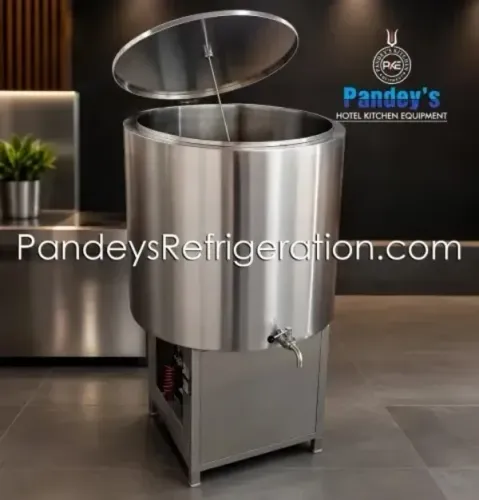
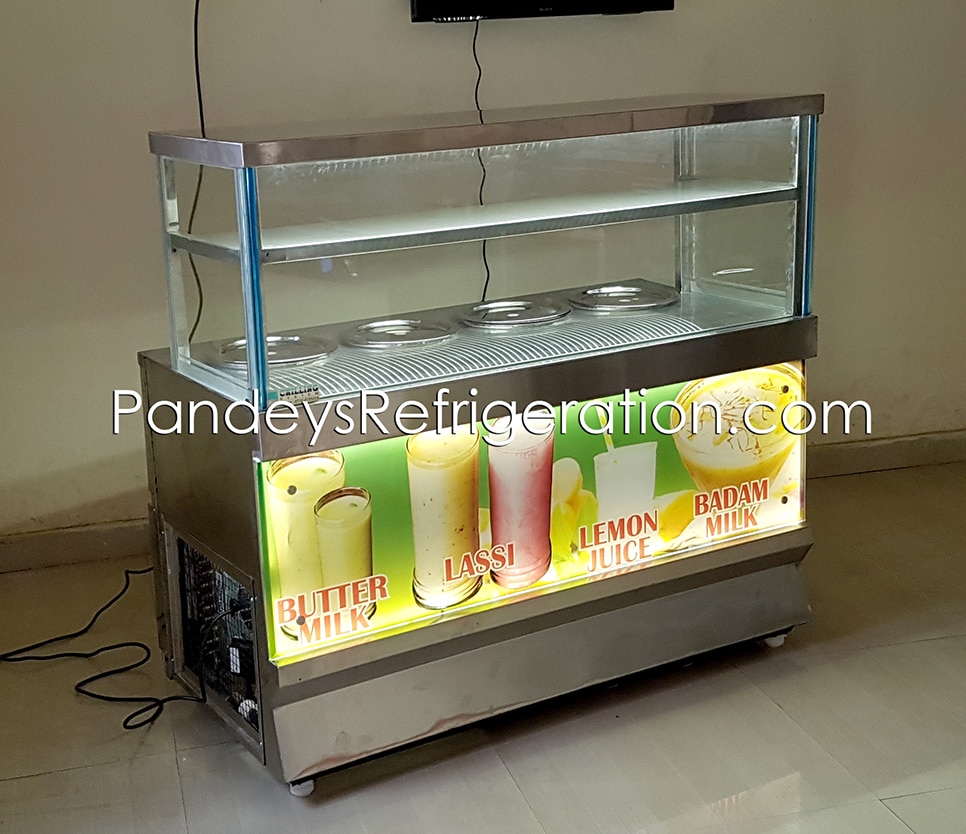 | Hotel Equipments The SS Lassi Counter by Pandeys Hotel Kitchen Equipment is designed for efficient preparation, storage, and serving of fresh lassi, buttermilk,... View product → |
What live tests should you complete before accepting the unit?
Do not approve the counter from photographs or a specification sheet. Use a commercial lassi counter checklist during a live demonstration, with your own thermometer and the electrical conditions at your shop. If your search began with lassi counter for buying problems in Nagpur, treat this inspection as acceptance evidence.
1. Load the tank or pans normally, record the product temperature, open the service area repeatedly, and confirm the lassi stays at or below 5°C. A cabinet reading 2–4°C is not enough if the product is warmer.
2. Run refrigeration continuously, check compressor starting behaviour, condenser airflow, unusual noise and temperature recovery after each opening. Record running current, voltage, plug rating, earthing and overload protection.
3. Switch on display lights and the blender or mixer while refrigeration runs. Test the actual circuit for nuisance tripping, loose plugs and heating at terminals; do not rely on a long extension lead.
4. Operate every tap repeatedly. Check smooth flow, leaking stems, nozzle removal and drip-tray fit.
5. Fill the sink, open the drain and inspect underneath for slow flow, leaks, blocked traps and standing water.
6. Remove baffles, agitator parts, tap nozzles, pans and drip trays. Brush each dairy-contact surface and reject fixed tubes or inaccessible dead legs.
7. Push the loaded counter, check rocking, levelling feet and castors, then inspect welds, corners, glass, seals, fasteners, scratches and unfinished underside areas. Record defects and obtain written correction before making final payment.
Frequently asked questions
How do I check whether a lassi counter will fit my shop’s service route?
Mark the counter footprint, door swings, queue line, staff passage and delivery path on the floor. Measure the narrowest working point after installation, not just the wall space.
What should I verify about the cooling system and capacity?
Ask for the cooling method, electrical load, tank capacity, operating temperature range, recovery time and performance under a full peak-period load. Confirm which items are included in the quoted capacity.
How can I tell whether a lassi counter is easy to clean?
Open every access panel and inspect tanks, drains, corners, welds, splash zones and food-contact surfaces. Reject areas that trap residue or require tools to reach during daily cleaning.
What should a Nagpur supplier include in writing before delivery?
Request a signed specification showing external dimensions, SS grade, equipment list, electrical details, warranty terms, delivery scope, installation responsibility and exclusions.
What live tests should I complete before accepting the unit?
Run the cooling system, switches, lights, drain and water connections. Check temperature performance, leaks, door alignment, vibration, finish quality and access to cleaning points before signing acceptance.
Keywords