Banquet bars face different demands from fixed restaurant bars: service peaks are short, layouts change, and equipment must fit through the venue before it performs under pressure. Use the guidance below to size the station, plan its wet and electrical services, compare construction options, and test the supplier’s quotation before placing an order.
Key takeaways
- Size active counter space for simultaneous bartenders and service points.
- Show water, drainage, power, gas, ice and waste connections on the utility plan.
- Specify steel grade, welded joints, finish, drainage and cleanable corners.
- Accept the station only after testing utilities, cleaning access and workflow.
How to size an SS bar station for a banquet hall
Plan for the bartenders working simultaneously, not the total guest count. A wedding with 500 guests and two bartenders needs less active counter than a conference with 250 guests and six service points.
Allow roughly 900–1,200 mm of linear worktop per bartender, 650–750 mm working depth and 900–1,050 mm finished height; confirm equipment sizes before fixing dimensions.
- Keep bottle storage and the speed rail at arm’s reach.
- Place the ice bin, bottle wells, garnish preparation and sink in the wet zone.
- Provide glass access above or beside the worktop, waste below preparation, and a clear pass-through toward guests or runners.
- Reserve under-counter space for refrigeration, glassware, waste bins and leg movement; do not block condenser ventilation with stored items.
For an SS bar station for banquet halls in Nagpur, choose the format against guest movement and the building route, not appearance alone.
| Format | Strength | Choose it when |
|---|---|---|
| One long run | Fast linear service | One wall has adequate length and the doorway, lift and stairs permit delivery |
| Two-sided island | Serves two directions | Guests or runners approach from opposite sides and separate service points reduce crossing |
| Sectional modules | Easier transport and replacement | Doorway width, lift capacity, stair access, floor level or final position prevents a welded one-piece counter |
Measure wall offsets, drainage route, electrical path and final placement before fabrication. A modular station needs sealed joints; a mobile caterer’s unit needs locking castors rated for its fully loaded weight.
What the banquet-bar layout and utility plan must show
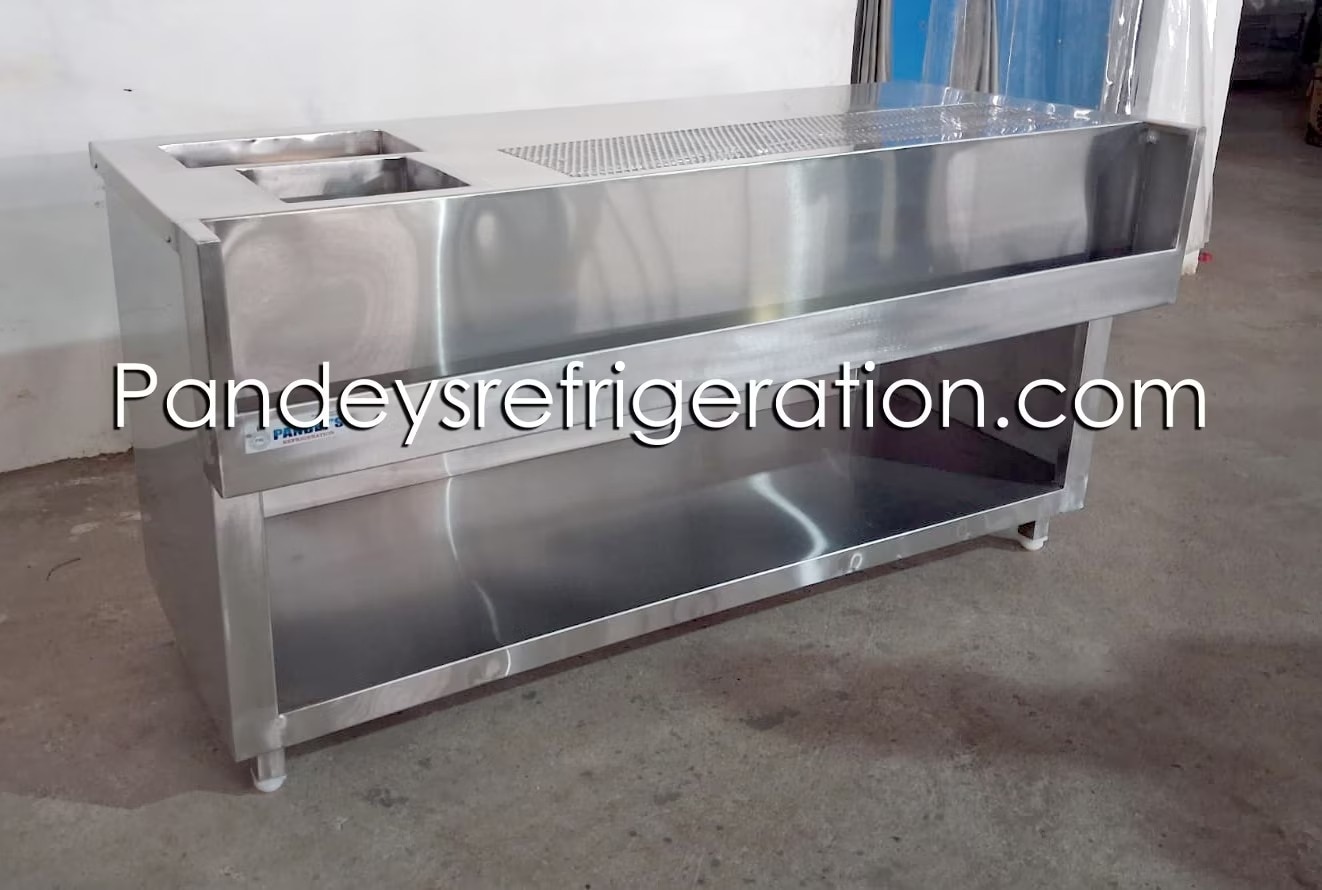
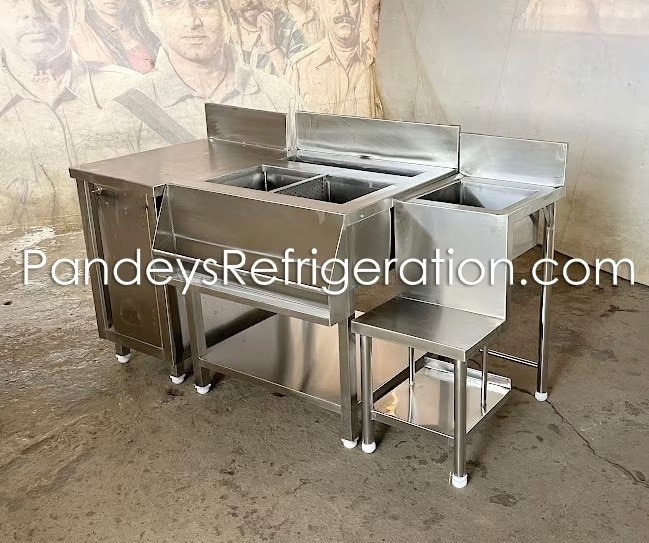
The drawing must show a service sequence, not just a stainless-steel box. Keep the speed rail and bottle wells within the bartender’s reach; place the ice bin and garnish area in the wet zone, with the sink and drainboard beside preparation.
Put the glass rack above or beside the worktop, the blender shelf near dedicated sockets, the waste opening below preparation, and storage or refrigeration under the counter.
1. Mark the service side, pass-through, bartender standing positions and every component on plan and elevation. Confirm that staff can reach ice, bottles and glasses without crossing the guest side or walking around an island.
2. Before fabrication, record the doorway width, lift capacity, stair route, floor level, wall offsets and final position. A commercial bar work station near Nagpur may need sectional modules instead of a welded one-piece counter.
3. Ask for the water-inlet point, trapped waste outlet, drainage route and slope, accessible clean-out, socket positions, earthing and residual-current protection. Specify separate electrical loads for the blender, glasswasher, refrigerator and ice machine.
4. Show refrigerator ventilation clearance, condenser air direction and removable service panels. Keep the trap and connections serviceable after fitting the cabinet and kick plate.
Never discharge refrigeration heat into a sealed cabinet or block the condenser with stored goods. Keep sockets, cable glands and isolators away from leak paths; stainless steel does not make an unsafe electrical connection safe.
How to check stainless-steel construction, finish and hygiene details
A suitable wet-bar station has documented materials, sealed wet zones and no place for liquid to hide—not merely a polished appearance at handover. For a stainless steel bar counter for resorts in nagpur, verify AISI 304 for the worktop, sink, shelves, legs and panels.
Specify AISI 316 when saline water, chloride exposure or aggressive cleaning chemicals raise the corrosion risk.
1. Request sheet thickness in millimetres for every component: worktop, sink, undershelf, doors, panels and legs. A single “18-gauge” claim is inadequate; 0.9 mm, 1.2 mm and 1.5 mm may suit different parts.
2. Inspect wet-zone joints for continuous sealing or full welding. Reject open folded seams, exposed screw heads, sharp internal corners and untreated cut edges, which trap syrup, soil and water.
3. Confirm radiused internal corners, a positive fall towards the sink or drain, treated edges, and sealed backsplash, wall junction and floor junction. An unsealed rear gap turns spilled citrus or wash water into hidden contamination.
4. Specify cleaning by surface and residue: remove syrup and citrus promptly, rinse dairy from contact areas, wash ice-contact surfaces, flush drain lines and dry standing water. Use a non-chloride cleaner and soft cloth; never use carbon-steel wool, hydrochloric acid or chloride-rich chemicals.
An insulated, drained ice bin is not an ordinary steel box: insulation slows melting, while a dedicated drain removes meltwater without flooding the worktop or contaminating ice. Verify its liner, insulation, drain connection and clean-out access.
Which bar format and supplier quotation fits your operation
A caterer needs a bar that arrives, locks in place and leaves without damaging the venue; a resort needs a fixed finish that survives daily service. Choose the format before comparing steel or running-metre prices.
| Format | Best fit | Main trade-off |
|---|---|---|
| Fabricated bar counter | Permanent banquet or resort installation | Strong appearance, but difficult to move or modify |
| Modular cocktail counter | Repeated layouts and changing venues | Faster replacement, but joints need proper sealing |
| Wooden-front bar | Guest-facing spaces where appearance leads | Harder cleaning and repairs around moisture |
| Portable catering bar | Off-site events and temporary service | Limited refrigeration and storage capacity |
| Purpose-built stainless-steel work station | Heavy wet use and rapid cleaning | Less decorative unless finished with cladding |
For a bar work station manufacturer for caterers in Nagpur, specify locking castors rated for the fully loaded unit, removable speed rails, detachable splashbacks, quick-access panels, and protected power and drain connections. Resorts can prioritise fixed finishes, concealed services, refrigeration capacity and clear condenser ventilation.
Ask every supplier for:
- Fabrication drawings with overall dimensions, working height, sink and drain locations, and transport sections
- AISI 304 or 316 grade, thickness for each component, and weld finish
- Refrigerator model, usable volume, temperature range, ventilation clearance and electrical load
- Installation exclusions, warranty coverage and commissioning tests
Pandey's Refrigeration belongs in the same comparison as other fabricators only after you price transport, site modification, drainage, electrical work and ventilation separately. The cheapest running metre can become the costliest installed station.
Related product
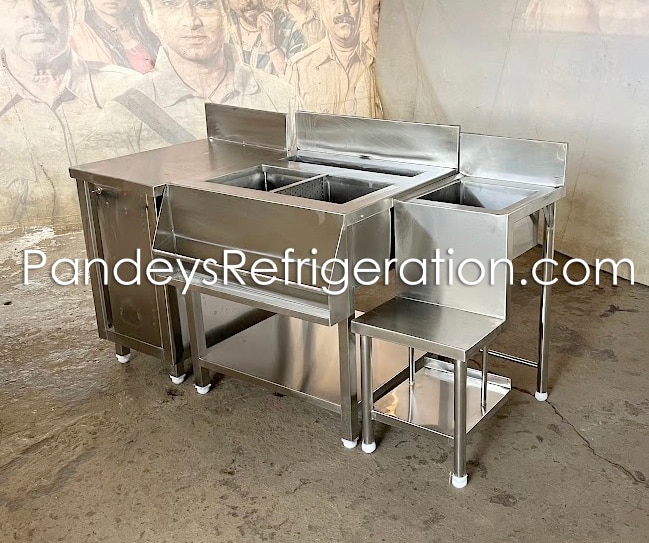 | Hotel Equipments If you're looking for a Stainless Steel (SS) Bar Work Station from Pandey's Hotel Kitchen Equipment, it is designed for efficient beverage... View product → |
How to install, clean and accept the station before service
Before delivery, confirm doorway width, lift capacity, stair access, floor level, wall offsets and the final service position. Ask the SS bar work station supplier for banquet bars in Nagpur whether the counter arrives as one piece or sectional modules, and identify every joint, connection and site modification.
- Position the station, level the legs, then anchor fixed feet or lock every castor. Seal the backsplash, wall junction and floor junction with suitable sanitary sealant.
- Connect the trapped waste and accessible clean-out after the cabinet, refrigeration unit and kick plate are installed. Keep every service panel removable.
- Run water through the sink, spray tap and any other connection. Check for leaks, drainage speed, trap odour and clean-out access.
- Fill and drain the sink, then inspect the worktop for ponding. Open every door and drawer with adjacent equipment in its final position.
- Run each refrigerated compartment through pull-down and record its temperature against the specified operating range. Complete electrical safety, earthing and residual-current protection checks.
- Pour water into the ice-bin drain and confirm discharge without splash, standing water or backflow toward ice-contact surfaces.
On service days, wipe syrup and citrus spills immediately, remove dairy residue, sanitise glass-contact areas and flush the drain line when odour appears. After the event, empty and rinse wet areas, dry the worktop, sink, ice bin and joints, and leave doors and panels open until moisture is gone; standing water causes corrosion staining.
Frequently asked questions
How should you size an SS bar station for a banquet hall?
Base the size on the number of bartenders working simultaneously, service points, drink menu, ice demand, glassware and storage—not only guest count.
What must a banquet-bar layout and utility plan show?
Show the station footprint, bartender positions, work zones, sinks, drainage, power points, refrigeration, ice storage, waste route and access for cleaning and maintenance.
How do you check stainless-steel bar-station construction and hygiene?
Check the specified steel grade, smooth welded joints, consistent finish, sealed seams, rounded cleanable corners, stable legs, drainage and accessible surfaces.
What should an SS bar-station quotation include?
Require dimensions, steel grade and thickness, components, finish, utility points, delivery, installation, testing, warranty, exclusions and a completion timeline.
How do you accept a bar station before service?
Run water and drainage tests, inspect welds and surfaces, check refrigeration and power, verify doors and drawers, clean the station, and record defects before handover.
Keywords