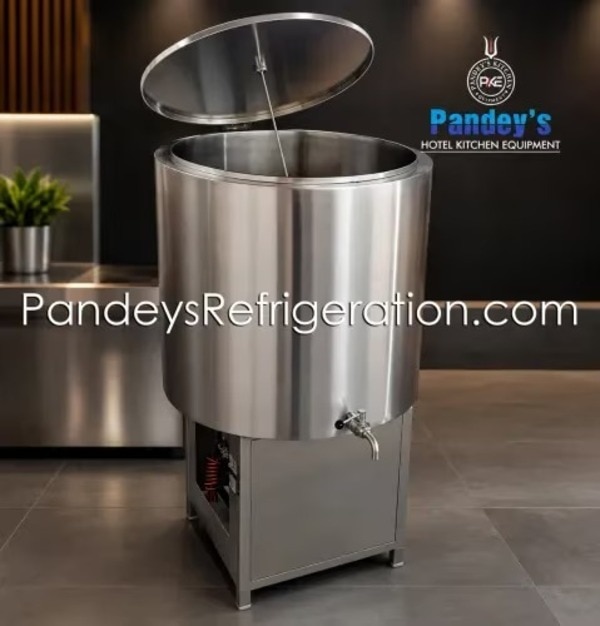
A tank’s advertised litre capacity and compressor horsepower do not prove that it will cool your milk quickly, evenly, or safely during Nagpur’s hottest operating conditions. Use the checks below to size the unit, specify a measurable cooling result, inspect food-contact construction, and accept the installation with evidence rather than promises.
Key takeaways
- Size the tank from peak litres received, not the advertised capacity.
- Demand cooling test results at Nagpur’s design ambient temperature.
- Inspect welds, agitator access, drain points and clean-in-place practicality.
- Witness the final cooling, agitation, electrical and safety acceptance tests.
Size the Chiller From Your Actual Milk Flow
Choose capacity from your milk flow, not the number painted on the tank. Record litres received in one batch, deliveries per day, peak demand, and reserve volume for delayed collection or sudden service.
A 500-litre tank does not provide 500 litres of usable cooling capacity. Cooling 500 litres from 35°C to 4°C requires about 17.3 kWh of product heat alone, using milk density of 1.03 kg/L and specific heat of 3.9 kJ/kg·K. Ask the supplier to add tank heat gain, agitator heat, compressor cycling, and lid-opening losses.
| Operating pattern | Capacity figure to specify | Suitable use |
|---|---|---|
| Batch chilling | Litres per batch, freeboard, inlet temperature, pull-down time | Hotel receiving 120 litres each morning |
| Continuous throughput | Litres per hour, inlet and outlet temperatures, recovery time | Collection point receiving warm cans throughout the day |
Do not load warm milk into a nearly full tank and expect its original rating to hold. Define these items in your milk chiller buying checklist:
- Milk volume and container type
- Maximum loading pattern and reserve volume
- Batch or continuous operation
- Raw, pasteurised, or finished dairy product
A hotel unit needs freeboard and a fast pull-down cycle; a collection unit needs sustained hourly performance. Treating either as a beverage refrigerator or blast chiller creates hotel milk chiller problems.
Demand a Tested Cooling Result at Nagpur’s Design Ambient
An SS milk chiller in Nagpur must prove its cooling result at the ambient temperature it will face, not merely display a large tank or compressor rating. Require a written pull-down test naming:
- Starting milk temperature
- Milk volume and loading pattern
- Target product temperature
- Maximum pull-down time
- Ambient temperature
- Holding temperature after pull-down, such as 4°C or another agreed value
FSSAI dairy hygiene requirements call for milk to reach 4°C or below as soon as possible. Reject “high-speed cooling” as an acceptance standard.
Compare net milk-cooling performance at the same ambient condition:
| Quotation figure | Acceptable evidence | Why it matters |
|---|---|---|
| Ambient condition | Stated Nagpur design ambient | Hot air raises condensing pressure and energy use |
| Cooling result | Litres, starting temperature, target, and minutes | Reveals actual pull-down capacity |
| Installation limits | Condenser clearance, ventilation, maximum room temperature | Prevents summer performance loss |
| Holding performance | Final milk temperature after pull-down | Confirms safe storage, not just initial cooling |
During commissioning, place a calibrated independent probe in the milk at the tank centre and near the outlet. Record time-stamped temperatures, controller set point, compressor run time, agitator operation, ambient temperature, and final holding temperature. A display reading of 4°C proves nothing if the milk is stratified or the outlet remains warm.
Use your actual volume, or an agreed water-load simulation, for a witnessed test. A chiller that passes in a cool room can fail in Nagpur’s summer heat.
Inspect the Milk Side, Agitator and Cleaning Design
Hygiene and safe cooling depend on the milk-contact surfaces, not a polished outer cabinet. Specify the stainless-steel grade for every wetted part: tank, outlet valve, agitator shaft, manhole, fittings and weld repairs. SS 304 is the usual baseline; SS 316 gives greater resistance to chloride and chemical attack.
- Ask for the internal surface finish and photographs or inspection access to internal welds.
- Reject pits, crevices, exposed threads, rough welds and stagnant pockets; continuous smooth welds are easier to clean and less likely to retain milk.
- Confirm that the outlet drains the tank completely without manual scooping or trapped liquid.
- Check that the manhole opens fully, the outlet valve is removable or cleanable, and spray coverage or manual access reaches the outlet and agitator.
- Do not treat “food-grade stainless steel” or a shiny exterior as proof of grade or weld quality.
| Product handled | Main contamination and cleaning concern | State in the order |
|---|---|---|
| Raw milk | Clean promptly after each load; control residues and cross-contamination | Product, maximum load and cleaning cycle |
| Pasteurised milk | Protect the closed product from post-process contamination | Hygienic transfer and covered loading method |
| Finished dairy beverage | Confirm ingredients do not leave sticky or corrosive deposits | Product formula and chemical compatibility |
Request the detergent and sanitiser sequence, concentration, temperature, rinse requirement and drying method. “CIP-ready” proves nothing without this information. For direct-expansion units, verify the agitator interlock, low-temperature cut-out, probe position, alarm history and minimum agitation duty during cooling; these controls limit local freezing when agitation stops.
Compare the Refrigeration, Electrical and Service Specification
Before comparing prices, require the commercial milk chiller supplier to disclose the complete refrigeration, electrical and service specification.
- Refrigeration: refrigerant name and charge quantity; leak-test procedure; required service tools; compressor brand, model and rating; condenser design; evaporator arrangement; insulation thickness; thermostat or controller type; and written compressor, low-temperature and freeze protections.
- Operation: state whether the evaporator contacts the tank directly or uses a jacket or secondary circuit. Ask how freezing is prevented when agitation stops, including the agitator interlock, probe location, low-temperature cut-out, alarm history and minimum agitation duty.
- Electrical: single- or three-phase supply, rated and starting current, voltage operating range, phase-sequence and phase-loss protection, earthing requirements and generator compatibility. A buyer-supplied stabiliser does not replace compressor or controller protection.
- Service: local trained technician availability, refrigerant and spare-parts access, and whether refrigerant replacement requires a compressor or controls change.
Compare the offer on these dimensions:
| Specification | Acceptable disclosure | Risk if missing |
|---|---|---|
| Refrigeration | Named refrigerant, charge and leak-test method | Costly fault-finding or unavailable gas |
| Electrical | Current, voltage range and phase protections | Trips, motor damage or unsafe operation |
| Service | Response time, warranty, training and covered installation | Long downtime after failure |
A quotation from Pandey's Refrigeration should separate these items from optional accessories and state installation, training, warranty and service response. Compare operating and repair risk, not stainless-steel appearance or horsepower alone.
Related product
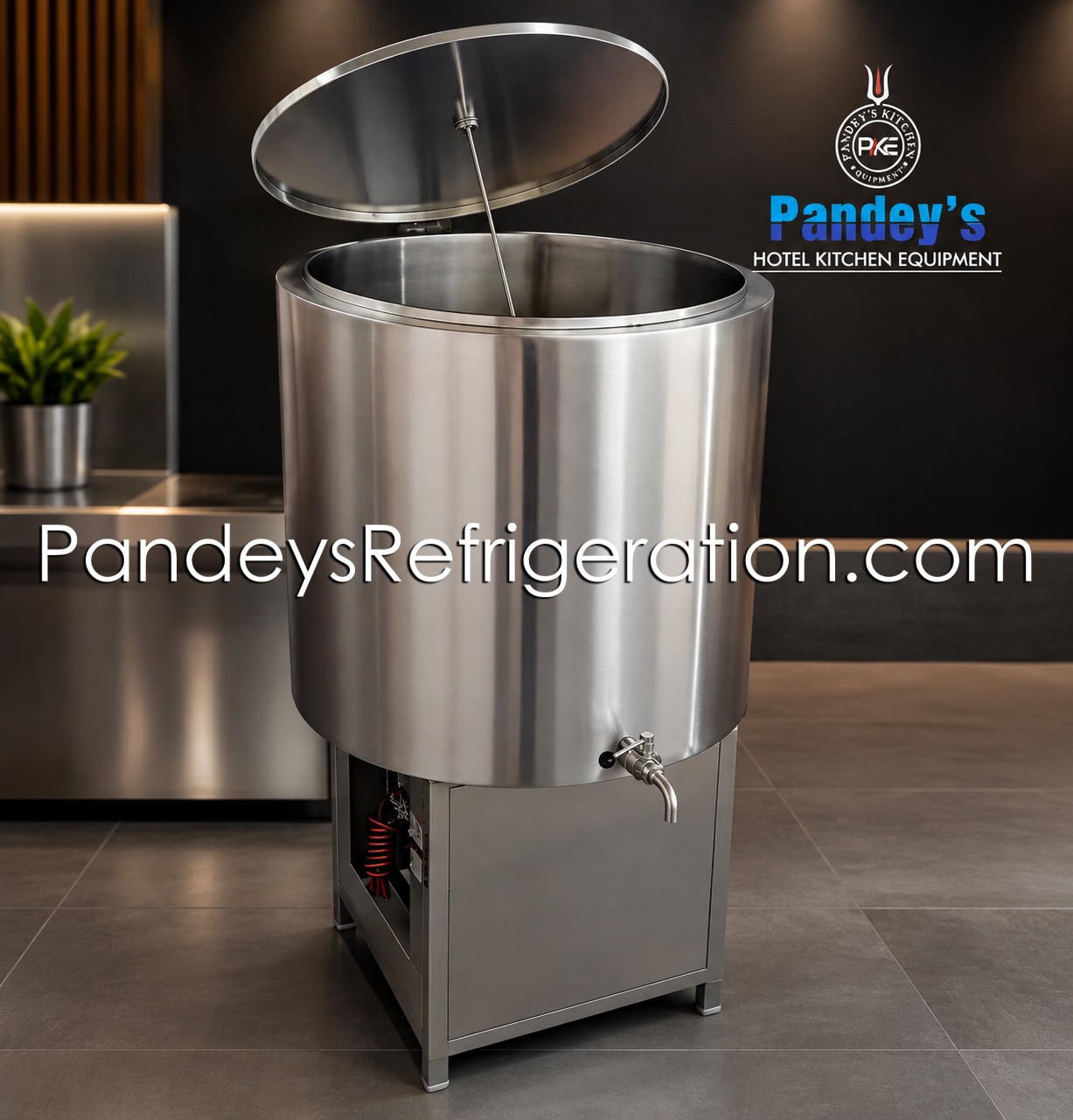 | Hotel Equipments The SS Milk Chiller by Pandeys Hotel Kitchen Equipment is a high-performance refrigeration unit designed to rapidly cool and safely store fresh milk... View product → |
Plan the Installation and Witness the Acceptance Test
Prevent ss milk chiller buying problems in Nagpur by treating the installation site as part of the purchase, not as an afterthought.
1. Reserve clearance around the condenser for airflow, cleaning and service access. Leave enough room to remove the compressor and controls without dismantling walls or nearby equipment.
2. Keep the chiller away from ovens, steam equipment, direct sunlight and poorly ventilated cold rooms. These heat sources raise condensing temperature and can make a hot-corner installation look like compressor failure.
3. Provide a washable floor and a nearby drain where wet cleaning is expected. Write the clearance, ventilation, maximum room temperature, floor and drainage requirements into the purchase order.
4. Require a witnessed site acceptance test using your actual milk volume or an agreed water-load simulation. Record inlet temperature, target temperature, pull-down time, ambient temperature, electrical current, drainability, controller reading and independent calibrated-probe readings.
5. Test the tank centre and outlet area after the agitator has operated, then test restart after a power interruption. “The compressor starts” and “the unit runs empty” are not acceptance tests.
6. Keep the signed result, probe calibration certificate, wiring diagram, cleaning instructions, refrigerant record, preventive-maintenance schedule and alarm settings in the equipment file.
Reject or correct the unit if it misses the written product-temperature result, leaves trapped liquid or cannot recover within the agreed time after the next batch arrives.
Frequently asked questions
How should you choose the capacity of an SS milk chiller?
Use actual milk flow records: litres per batch, deliveries per day, peak demand and reserve volume for delayed collection or sudden service.
What cooling result should you demand from a milk chiller in Nagpur?
Ask the supplier to demonstrate the specified milk temperature, pull-down time and recovery performance at Nagpur’s design ambient, with the result recorded in the acceptance test.
Which milk-contact and cleaning features should you inspect?
Inspect the stainless-steel grade, internal weld finish, tank slope, drainability, agitator, access openings and the cleaning method required between batches.
What should a milk chiller installation acceptance test include?
Check refrigeration operation, electrical protection, agitator performance, drainage, temperature readings, alarms and the final cooling result under your actual operating conditions.
Keywords